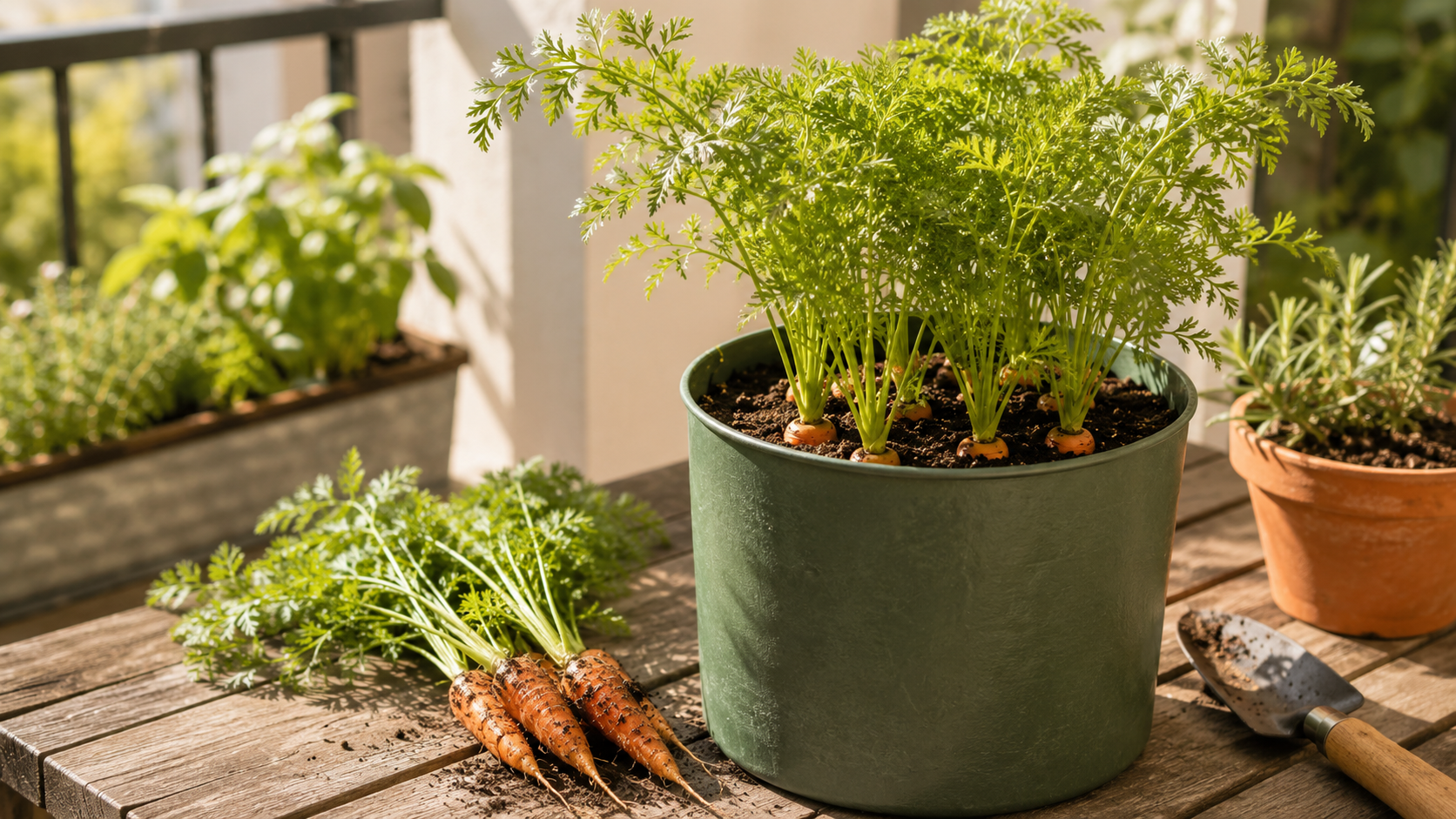
Quick answer: Carrots grow well in containers when the pot is deep enough for the variety, the compost is fine and stone-free, and the seedlings are not crowded. Choose short, round or baby-root varieties for smaller pots, sow directly into the final container and keep the compost consistently moist while the seeds germinate.
Growing note: Carrots dislike root disturbance, so do not start them in seed trays for transplanting. Sow them where they will grow and harvest.
Quick facts
| Best for | Patios, balconies, courtyards, raised beds and sunny tiny gardens |
| Difficulty | Beginner-friendly with careful sowing and watering |
| Container depth | About 25–30cm for short varieties; deeper for longer roots |
| Sunlight | Full sun or light partial shade |
| Best tiny-garden choice | Short-rooted, round or baby carrots |
Why carrots are useful in containers
Container carrots make good use of depth rather than width. A tall pot can hold a useful crop without taking over the whole patio, and fresh compost can be easier to manage than stony garden soil. Containers also let you place the crop where it receives good light and where you can protect it more easily.
The main challenge is patience. Carrot seed is small, germination can be slow and the seedlings need thinning if they are crowded. The reward is a crop that can be harvested a few roots at a time.
Choosing the right carrot variety
Match the root shape to your container. Long maincrop carrots need deep, unobstructed compost. Short-rooted, stump-rooted and round carrots are better choices for ordinary patio pots and troughs.
| Carrot type | Container suitability |
| Round or globe | Useful for shallower containers |
| Short or stump-rooted | Good general choice for patio pots |
| Baby carrots | Harvested young and suitable for repeat small sowings |
| Long maincrop | Needs a deep container and careful moisture management |
Read the seed packet before buying. A compact top does not necessarily mean a short root, so look for a clear description of the root shape.
Choosing a container
For most short carrots, aim for a container around 25–30cm deep. Deeper is helpful because it holds moisture more steadily and gives roots room to develop. Wide pots, deep troughs and sturdy buckets with drainage holes can all work.
Do not use a container without drainage. Carrots need moisture, but waterlogged compost can lead to poor growth and damaged roots. If you reuse a bucket or storage tub, add enough drainage holes before filling it.
The best compost for container carrots
Use a fine, free-draining peat-free compost without large pieces of bark, stones or compacted lumps. Break up clods with your hands and remove anything that could force the roots to fork. Avoid adding fresh manure, which can encourage distorted roots.
Fill the container nearly to the top, water it well and allow the compost to settle before sowing. Top it up if the level drops significantly.
How to sow carrots in pots
- Place the container in its final position before filling if it will be heavy.
- Fill with fine, free-draining compost and water before sowing.
- Make shallow drills or sow across the surface according to the packet instructions.
- Sow as thinly as possible. Mixing the seed with a little dry sand can help you spread it more evenly.
- Cover lightly, label the pot and water gently.
- Keep the surface moist while the seeds germinate. A temporary cover can reduce drying, but remove it once seedlings appear.
- Thin crowded seedlings carefully, preferably when the compost is damp.
Where to position container carrots
Carrots prefer good light. A sunny patio or balcony is ideal, although light partial shade can still produce a crop. Keep the pot away from places where roof runoff or automatic watering will flood it.
If carrot fly is a problem locally, a container does not guarantee protection. Insect-proof mesh gives more reliable protection than relying on height alone.
Watering carrots in containers
Keep the compost evenly moist from sowing onwards. The surface is especially vulnerable while the seeds are germinating. Once the plants are established, water deeply enough to reach the lower roots rather than repeatedly wetting only the top few centimetres.
- Check pots regularly during dry or windy weather.
- Water slowly so the compost absorbs the moisture.
- Avoid letting the container dry completely and then soaking it.
- Do not leave the pot sitting in water for long periods.
Thinning without damaging the crop
Crowded carrots cannot form good roots. Thin the weakest seedlings and leave the stronger ones at the spacing recommended on the packet. Try not to disturb neighbouring roots. Water afterwards to settle the compost.
Remove thinnings and damaged foliage rather than leaving the scent around the container. If carrot fly is common in your area, thin carefully and consider doing it later in the day when the insect is less active.
How to know when carrots are ready
The seed packet will give an approximate harvest time, but you can also inspect the shoulders of the roots at the compost surface. Pull one as a test. Baby carrots can be harvested early, and removing alternate roots can give the remaining plants more room.
Watering the container shortly before harvesting can make roots easier to pull without snapping.
Common container-carrot problems
Forked or twisted roots
The usual causes are stones, compacted compost, fresh manure or root disturbance. Use fine compost and sow directly into the final container.
Tiny roots
Overcrowding, insufficient depth, weak light or inconsistent watering can limit growth. Thin the seedlings and check that the container suits the variety.
Seeds fail to germinate
The surface may have dried out, the compost may have crusted, or the seed may have been sown too deeply. Keep the upper layer consistently moist and follow the packet depth.
Carrot fly damage
Use insect-proof mesh secured around the whole container. Gaps reduce its effectiveness.
A simple succession plan
Sow a modest container in spring, then make another small sowing a few weeks later if you have space. Harvest baby roots rather than waiting for every carrot to become large. This approach suits a tiny garden and spreads the crop over a longer period.
Carrots also fit well into the monthly sowing plan. See what to sow in April and what to sow in May.
Is your pot deep enough?
Check your container dimensions before sowing, especially if you are choosing a variety with longer roots.
FAQs
How deep should a pot be for carrots?
A depth of about 25–30cm suits many short-rooted varieties. Longer carrots need a deeper container, so always check the variety description.
Can I grow carrots in a window box?
Yes, if the box is deep enough and you choose short or round carrots. Shallow decorative boxes are usually better for salad leaves.
Do carrots need feeding in pots?
Fresh compost usually provides a good start. Avoid excessive high-nitrogen feeding, which can produce lots of foliage without improving the roots.
Can I transplant carrot seedlings?
It is best not to. Root disturbance can cause forked or misshapen carrots, so sow directly into the final container.
Growing note: Container depth should match the variety. A short-rooted carrot in a generous pot is much easier than a long maincrop variety in a shallow trough.