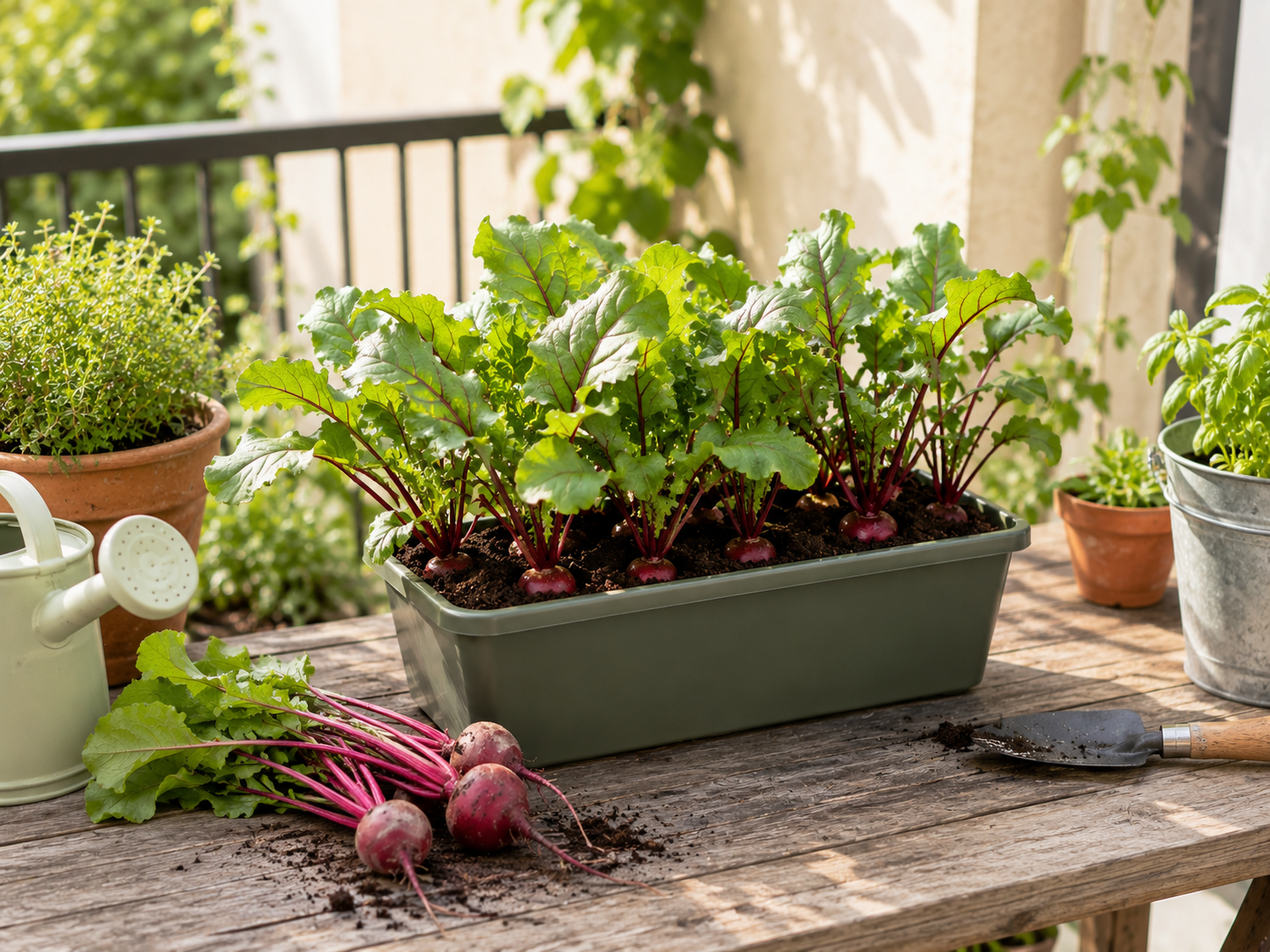
Quick answer: Beetroot grows well in containers, especially when harvested as tender baby roots. Use a pot or trough at least 20–25cm deep, sow the seeds directly into the final container, thin crowded seedlings and keep the compost evenly moist. Round varieties are the simplest choice for a balcony or patio.
Growing note: Beetroot seeds are usually clusters that can produce more than one seedling. Do not be surprised if several shoots appear from one spot.
Quick facts
| Best for | Balconies, patios, courtyards, raised beds and small gardens |
| Difficulty | Beginner-friendly |
| Container depth | 20–25cm minimum for round or baby roots |
| Sunlight | Full sun or light partial shade |
| Best harvest | Young roots around golf-ball size, plus edible leaves |
Why beetroot suits containers
Beetroot is compact, useful and forgiving. It does not need the depth of a long carrot, and you can harvest roots while they are still small. The leaves are edible too, so even a modest container gives you more than one kind of harvest.
It also fits neatly into a succession plan. Sow a small batch, harvest the largest roots first and make another sowing a few weeks later. This works better in a tiny garden than trying to produce one large crop all at once.
Choosing a variety
Round beetroot is usually easiest in pots. Baby-root varieties and compact cultivars mature quickly and need less depth than long cylindrical types. Check the seed packet for expected root shape and spacing.
| Type | Container suitability |
| Round beetroot | The easiest general choice for pots and troughs |
| Baby beetroot | Ideal for early harvesting and small containers |
| Cylindrical beetroot | Needs a deeper pot and more careful spacing |
| Leaf beet or chard | Grown mainly for leaves rather than swollen roots |
Choosing the right container
Use a pot, trough or window box at least 20–25cm deep. A wider container is useful because it lets you grow several roots without crowding. Make sure it has drainage holes and is stable when filled with wet compost.
One medium trough is easier to manage than several tiny pots. Very small containers dry quickly and leave little space for roots to swell.
How to sow beetroot in a container
- Fill a clean container with peat-free multi-purpose compost and level the surface.
- Water before sowing so the seeds stay in place.
- Make shallow drills or individual holes according to the packet instructions.
- Sow thinly and cover lightly with compost.
- Label the container and water with a gentle rose.
- Keep the compost evenly moist while seedlings emerge.
- Thin crowded seedlings, leaving the strongest plant at each station.
Thinning beetroot seedlings
Because a beetroot seed is often a cluster, several seedlings may emerge together. Thin them while they are small, ideally when the compost is damp. The young leaves can be added to salads if they are clean and healthy.
Do not leave every seedling in place. Crowded beetroot produces lots of leaves and very small roots.
Where to position the container
Beetroot grows best in good light, although it tolerates light partial shade. A sunny patio or balcony is ideal. In very hot weather, a little afternoon shade can help the compost stay moist.
On an exposed balcony, place the container where wind will not dry the leaves and compost too quickly.
Watering beetroot
Keep the compost moist but not waterlogged. Severe drying can make roots woody and may encourage premature flowering. Water slowly so moisture reaches the full depth of the pot.
- Check containers more often in warm or windy weather.
- Water at the compost level rather than only wetting the leaves.
- Do not leave the pot standing in water.
- Mulch the surface lightly if it dries very quickly.
Feeding container beetroot
Fresh compost usually provides enough nutrition for a small crop. Heavy feeding is rarely necessary. Too much nitrogen can encourage leaves at the expense of roots.
How to harvest
Harvest the largest roots first once they reach a useful size. Young beetroot is usually more tender than oversized roots. Twist off the leaves rather than cutting deeply into the crown, leaving a short stalk to reduce bleeding during cooking.
If roots are crowded, pulling alternate plants gives the remaining beetroot more room to grow.
Common problems
Lots of leaves but tiny roots
The plants may be crowded, shaded or overfed. Thin them and make sure the pot receives useful light.
Roots are woody
The crop may have been left too long or allowed to dry repeatedly. Harvest younger and maintain steadier moisture.
Plants flower early
Cold snaps, drought and stress can cause bolting. Keep the container watered and choose a bolt-resistant variety if this is a recurring problem.
Leaves are damaged
Aphids, flea beetles and leaf miners may affect the foliage. Check regularly and remove badly damaged leaves.
A simple succession plan
Sow one short row or small patch, then another two or three weeks later. Harvest baby roots from the first sowing while the second develops. This gives you a steadier kitchen supply and prevents the container becoming overcrowded.
Beetroot fits naturally into the spring calendar. See what to sow in April and what to sow in May.
Check your pot depth
Use the Container Size Calculator before sowing roots in a shallow window box or trough.
FAQs
How deep should a pot be for beetroot?
A depth of around 20–25cm is suitable for many round and baby-root varieties. Cylindrical beetroot needs more depth.
Can beetroot grow in partial shade?
Yes, although stronger light usually produces better roots. Light partial shade can be useful in hot weather.
Can I eat beetroot leaves?
Yes. Young healthy leaves can be eaten in salads or cooked, but do not remove so many that the root cannot continue growing.
Does beetroot need transplanting?
Direct sowing is simplest. Beetroot can tolerate careful transplanting when young, but sowing in the final container avoids unnecessary disturbance.
Growing note: Harvesting beetroot young is one of the easiest ways to get a useful crop from a small container.