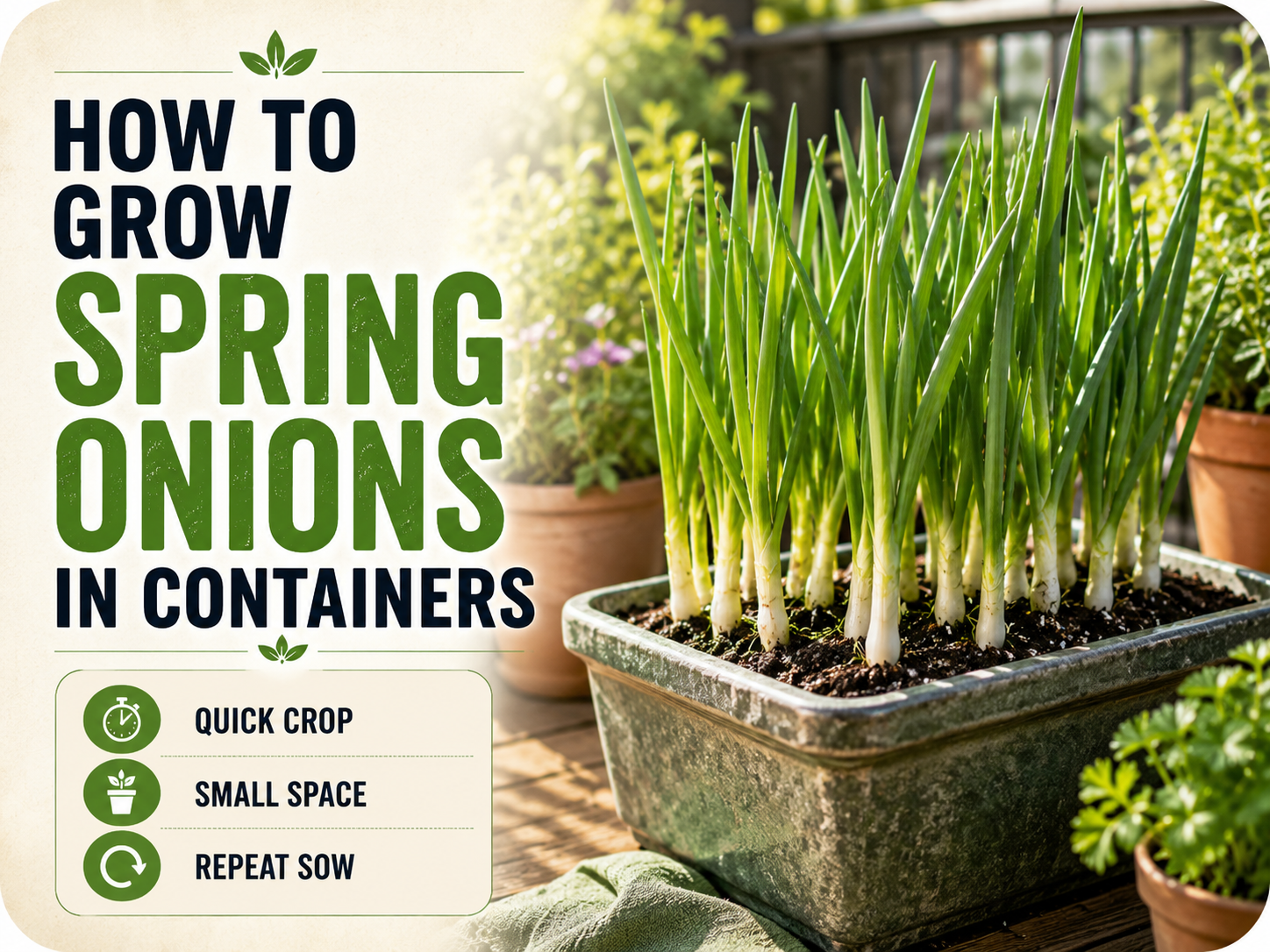
Quick answer: Spring onions are ideal for containers because they stay narrow, grow quickly and do not need deep soil. Use a trough or pot at least 15cm deep, sow thinly and make small repeat sowings every few weeks. Keep the compost moist and harvest while the stems are slim and tender.
Growing note: Spring onions are also sold as salad onions. The names are commonly used for the same quick-growing crop.
Quick facts
| Best for | Window boxes, troughs, balconies, patios and raised-bed edges |
| Difficulty | Very beginner-friendly |
| Container depth | Around 15cm minimum |
| Sunlight | Full sun or light partial shade |
| Best method | Small repeat sowings for steady harvests |
Why spring onions suit tiny gardens
Spring onions use very little width and can fit along the edge of a mixed container. They are useful in salads, stir-fries and garnishes, and you can harvest only what you need.
They also grow well in narrow troughs that are too small for hungry summer crops. For beginners, they are a forgiving way to practise sowing and watering.
Choosing a container
Use a window box, trough or medium pot at least 15cm deep. The surface area matters more than great depth because the plants form slender roots rather than large bulbs.
Drainage holes are essential. A long trough can become heavy when wet, so make sure rail-mounted containers are securely supported.
How to sow spring onions
- Fill the container with peat-free multi-purpose compost.
- Water before sowing.
- Make shallow rows or sow in small clusters according to the packet.
- Cover lightly and label the container.
- Keep the compost moist while seedlings emerge.
- Thin only if the plants are extremely crowded.
- Sow another short row two or three weeks later.
Where to position the pot
Spring onions grow best with good light but tolerate a little shade. A bright balcony, patio ledge or windowsill box can work. During very hot weather, afternoon shade can reduce drying.
Watering and feeding
Keep the compost steadily moist. Spring onions do not need heavy feeding in fresh compost. Excessive fertiliser can create soft growth without improving the crop.
- Check narrow window boxes often.
- Water gently so seedlings are not flattened.
- Avoid standing water.
- Use a larger trough if the compost dries too quickly.
Growing spring onions with other crops
Spring onions pair well with lettuce, radishes and baby beetroot because they occupy little horizontal space. Do not crowd them around a large tomato or courgette unless the container is generous enough for both crops.
For another compact crop, see how to grow radishes in containers.
Harvesting
Pull spring onions when the stems are pencil-thin or slightly larger, depending on the variety. Harvest alternate plants first if the row is crowded. Use them soon after picking for the best texture.
Common problems
Seedlings are very thin
They may need more light, more space or steadier moisture. Move the pot to a brighter position and thin severe crowding.
The tips turn yellow
Check for dry compost, waterlogging or depleted growing medium. Yellow tips can also appear naturally on older leaves.
Plants grow slowly
Cold conditions, shade and overcrowding can slow growth. Spring onions are tolerant, but they still need reasonable light and moisture.
The crop bolts
Stress and temperature swings can trigger flowering. Harvest affected plants and sow a fresh small batch.
A simple succession plan
Sow one short row now, another after two or three weeks and a third a few weeks later. This gives you a steady supply without filling the whole trough at once.
Spring onions fit naturally into April sowing and May container plans.
Match crops to your container
Use the free tools to plan a trough of spring onions, radishes and salad leaves.
FAQs
How deep should a spring onion pot be?
Around 15cm is enough for many varieties, although a deeper trough holds moisture more steadily.
Can spring onions grow indoors?
They can grow on a bright windowsill, but outdoor light usually produces stronger growth.
Can I regrow supermarket spring onions?
The roots can produce some new green growth in water or compost, but sowing seed gives a more reliable full crop.
Do spring onions need thinning?
Only if they are very crowded. Harvesting alternate plants can thin the row while giving you an early crop.
Growing note: Small repeat sowings are more useful than one dense row. They give you tender onions over a longer period.