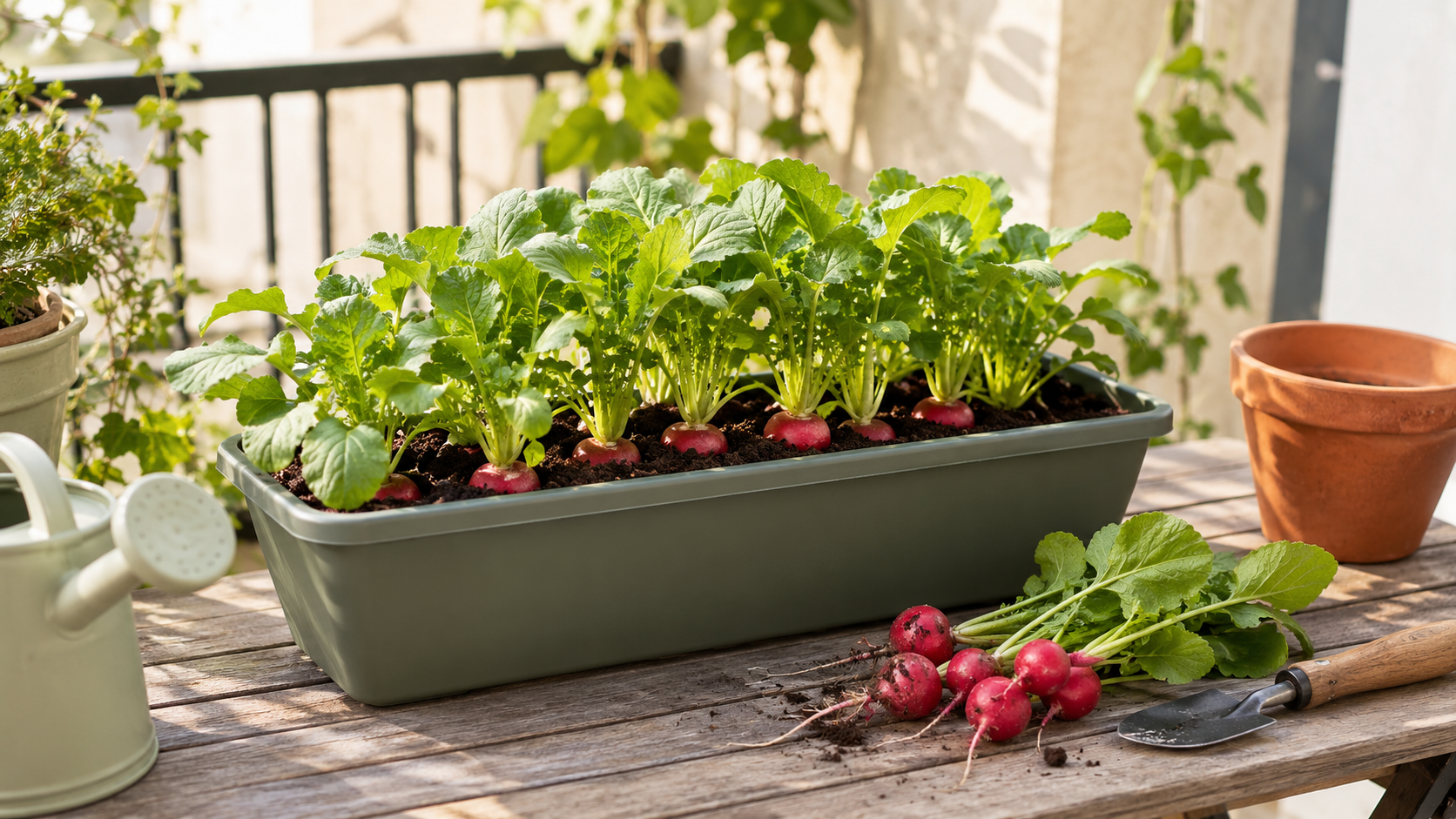
Quick answer: Radishes are one of the quickest and easiest crops to grow in containers. Use a pot or trough at least 15cm deep, sow the seeds thinly, keep the compost evenly moist and harvest the roots while they are young. For a steady supply, sow a short row or small patch every two weeks rather than filling the whole container at once.
Growing note: Radishes grow best in cool, steady conditions. Hot weather, dry compost and overcrowding can make the roots small, woody or excessively peppery.
Quick facts
| Best for | Balconies, patios, window boxes, raised beds and tiny gardens |
| Difficulty | Very beginner-friendly |
| Container depth | 15cm minimum; 20cm gives more reliable moisture |
| Sunlight | Full sun in cool weather; light afternoon shade in warmer weather |
| Typical harvest | Often ready within a few weeks, depending on variety and conditions |
Why radishes work so well in small spaces
Radishes earn their place in a tiny garden because they grow quickly and use very little room. You can fit a short row into a narrow trough, grow them between slower crops, or use a container that will later be needed for tomatoes or beans. By the time the summer crop wants the space, the radishes may already be on your plate.
They are also useful for learning the basics. Radishes show you why thin sowing, consistent watering and timely harvesting matter. If the roots stay thin, the leaves flop or the crop tastes harsh, the cause is usually easier to identify than it would be with a long-season vegetable.
Choosing a container for radishes
A window box, rectangular trough or wide bowl is ideal because radishes need more surface area than depth. The container must have drainage holes, but it should not be so shallow that the compost dries out after a few hours of sun.
| Container | Best use |
| 15–20cm deep window box | A neat row of radishes on a balcony or ledge |
| Medium trough | Repeat sowings or a mix with spring onions |
| Wide bowl | A compact patio crop that is easy to reach |
| Large mixed container | Short-term crop between slower vegetables |
Avoid sowing into a very small pot. It may hold enough compost for a few roots, but it will dry quickly and make regular watering harder. One medium trough is usually easier than several tiny pots.
Which radish varieties suit containers?
Most common radishes can grow in pots, but small round varieties and compact French breakfast types are especially convenient. Check the seed packet for spacing and expected root shape. If a variety produces long roots, give it a deeper container.
For a first attempt, choose a variety described as quick, early or suitable for forcing. Do not buy several packets at once. One reliable variety is enough to learn what works in your space.
How to sow radishes in a container
- Fill a clean container with peat-free multi-purpose compost and gently level the surface.
- Water the compost before sowing so the seeds stay where you place them.
- Make a shallow drill or press small holes at the spacing recommended on the packet.
- Sow thinly. Radish seeds are large enough to place individually if you take your time.
- Cover lightly with compost, label the container and water with a gentle rose.
- Keep the compost evenly moist while the seedlings emerge.
- Thin crowded seedlings early so the remaining plants have room to form roots.
Where to position the container
In spring and early autumn, radishes are happy in a bright, sunny position. During warmer weather, a little afternoon shade can help keep the compost cool and slow the crop from becoming stressed. A spot close to the kitchen door is useful because you are more likely to notice when the pot needs water or the roots need harvesting.
On a windy balcony, use a stable trough rather than a collection of light pots. Wind dries compost quickly, even when the air does not feel especially hot.
Watering radishes in pots
The aim is steady moisture rather than constant saturation. If the compost dries completely and is then soaked, the roots may split or develop an uneven texture. Check the container with a finger and water slowly when the upper layer begins to feel dry.
- Water the compost rather than splashing only the leaves.
- Check narrow window boxes often in warm or windy weather.
- Do not leave the container standing permanently in water.
- Move the pot into light shade during an unexpectedly hot spell.
How and when to harvest
Do not wait for every radish to reach the same size. Gently move the compost aside and check the shoulders of the roots. Harvest those that look ready and leave smaller ones to continue growing. Young radishes are usually crisper and milder than oversized roots.
If a root has become woody or hollow, harvest the rest promptly and adjust the next sowing. The usual causes are heat, dry compost, overcrowding or simply leaving the crop too long.
Common radish problems
Lots of leaves but tiny roots
The seedlings may be overcrowded, shaded or growing in compost that is too rich in nitrogen. Thin them, improve the light and avoid unnecessary feeding. Radishes normally do not need regular liquid fertiliser in fresh compost.
The roots are very hot or woody
Warm weather, drought stress and late harvesting can all increase the heat and reduce the crisp texture. Sow smaller batches, water consistently and harvest earlier.
Seedlings disappear
Slugs, snails and flea beetles may damage young growth. Check the plants regularly, keep the area around containers tidy and use appropriate physical protection if damage becomes serious.
Roots split
This often follows a dry spell followed by heavy watering. More consistent moisture is the best prevention.
A simple repeat-sowing plan
Sow a small patch now, then another patch around two weeks later. Continue while the weather is cool enough for good root growth. This gives you several small harvests rather than one large crop that must be eaten immediately.
Radishes fit naturally into the spring sowing calendar. See what to sow in March and what to sow in April for more small-space ideas.
Check your container before sowing
Use the free Container Size Calculator to check whether your pot or trough has enough depth for the crop you want to grow.
FAQs
How deep should a container be for radishes?
A container around 15cm deep can work for small round radishes. A depth of about 20cm is easier to keep moist and gives you more flexibility with variety choice.
Can radishes grow in a window box?
Yes. A window box is one of the best options, provided it has drainage holes and is stable enough for the location.
How many radishes can I grow in one pot?
That depends on the pot’s surface area and the spacing on your seed packet. Sow thinly and give each plant enough room to form a root rather than trying to maximise the number of seedlings.
Can I grow radishes all summer?
You can try, but they are often easier in spring and early autumn. In hot weather, use partial shade, keep the compost moist and choose varieties recommended for summer sowing.
Growing note: Seed packet instructions vary by variety. Use the packet spacing as your starting point, then adapt for your own container, weather and light.