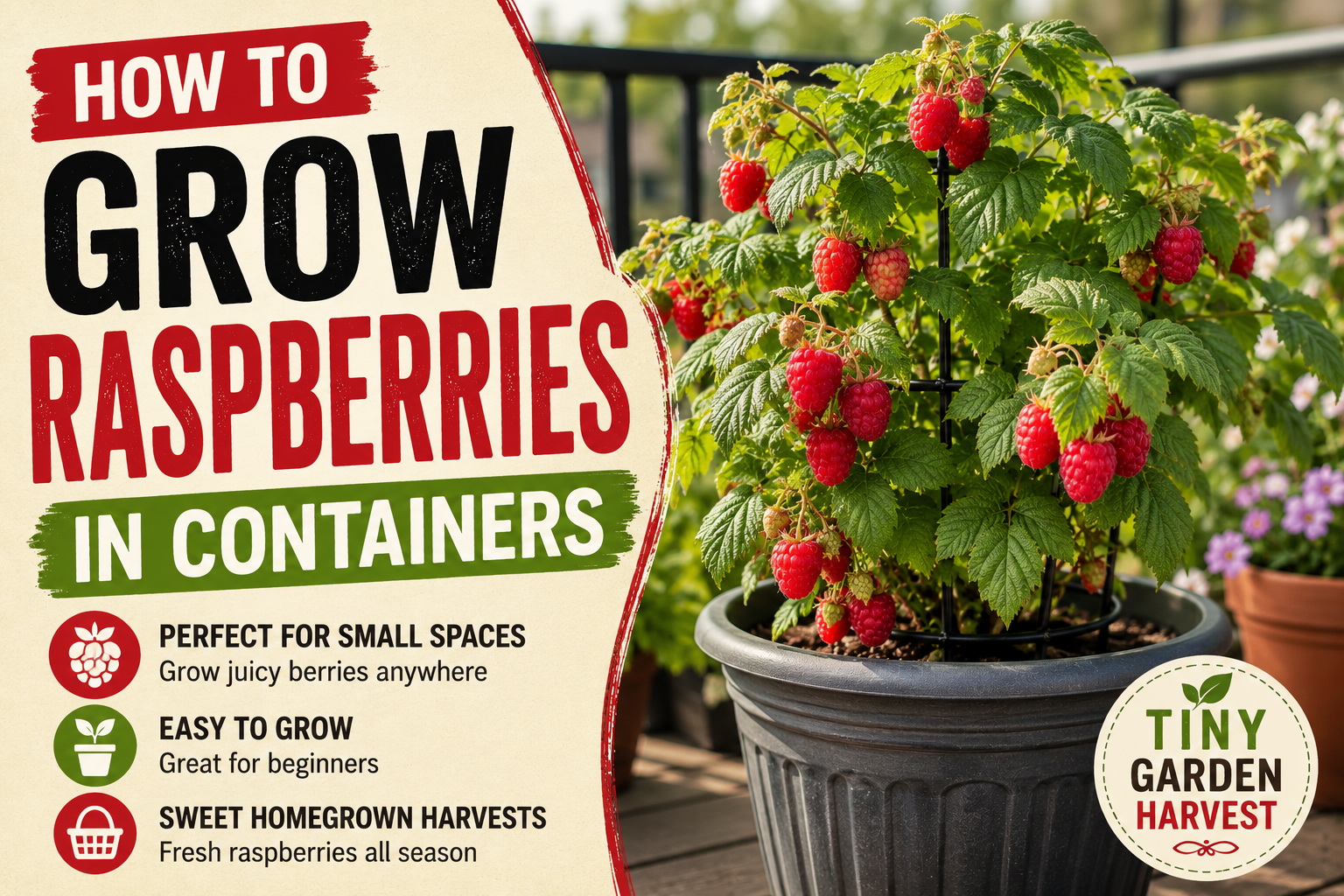
Quick answer: Raspberries can grow in containers if you choose a compact dwarf variety, use a large pot and provide strong support, steady moisture and regular feeding. Standard raspberry canes are usually better in the ground, so container growing works best with varieties specifically bred for patios or small spaces.
Growing note: Do not assume every raspberry is container-friendly. Check the mature size and choose a compact or dwarf cultivar.
Quick facts
| Best for | Sunny patios, courtyards and sheltered balconies |
| Difficulty | Beginner to intermediate |
| Container | A large stable pot for one compact plant |
| Sunlight | Full sun for the best crop; light partial shade tolerated |
| Main care needs | Water, feeding, support, pruning and bird protection |
Are raspberries good container plants?
Most raspberries are vigorous cane fruits and perform better in the ground. Compact modern varieties are the exception. These have shorter canes and are designed to crop from a large patio pot.
A container raspberry is a long-term plant, not a one-season vegetable. It needs a substantial pot, annual feeding and correct pruning. In return, it can provide fruit for several summers.
Choosing the right variety
Look for words such as compact, dwarf, patio or container on the label. Check whether the plant is summer-fruiting or autumn-fruiting, because the pruning method differs.
| Type | Pruning approach |
| Summer-fruiting compact raspberry | Remove old fruited canes after harvest; retain healthy new canes |
| Autumn-fruiting compact raspberry | Cut all canes down in late winter |
| Standard vigorous raspberry | Usually unsuitable for long-term container growing |
Choosing a container
Use a large frost-resistant pot with generous drainage holes. A container at least around 45–50cm wide gives the roots a more reliable volume of compost. Larger is easier to keep moist, but also becomes very heavy.
Put the empty pot in its final position before planting and check that a balcony or raised surface can safely carry the weight.
How to plant a raspberry in a pot
- Soak the nursery plant thoroughly before planting.
- Choose a large stable pot with drainage holes.
- Fill the base with peat-free soil-based compost.
- Remove the plant carefully and inspect the root ball.
- Plant at the same depth it was growing previously.
- Firm gently, water thoroughly and add a mulch.
- Install a cane or compact support frame immediately.
Where to position the pot
Choose a sunny sheltered position. Raspberries tolerate light partial shade, but fruiting and sweetness are generally better in stronger light. Shelter is important because loaded canes can snap in wind.
Watering container raspberries
Raspberries have shallow roots and dislike drought. Keep the compost evenly moist from flowering through fruiting. Large pots still need frequent checks during warm weather.
- Water slowly and deeply.
- Do not allow repeated severe drying.
- Avoid leaving the pot permanently waterlogged.
- Mulch the surface to protect shallow roots.
Feeding
Container raspberries benefit from regular feeding during the growing season. Use a suitable high-potassium or fruit fertiliser according to the label. Refresh the surface compost each spring.
Supporting the canes
Even dwarf raspberries may need support once they carry fruit. Use a sturdy cane, small obelisk or compact wire frame. Tie stems loosely with soft material.
Pruning
Pruning depends on whether the variety fruits on one-year-old or current-season canes. For autumn-fruiting raspberries, all canes are usually cut down in late winter. For summer-fruiting types, remove only the canes that have fruited and keep the new green canes.
Keep the plant label. Incorrect pruning can remove the following season’s crop.
Harvesting
Pick raspberries when they are fully coloured and come away easily from the central core. Harvest every day or two during the main crop because ripe fruit deteriorates quickly.
Common problems
The pot dries too quickly
The container may be too small or exposed. Move it to shelter, add mulch and consider repotting during the dormant season.
Few flowers or berries
Weak light, incorrect pruning, a young plant or depleted compost may be responsible. Check the variety instructions before changing the feeding routine.
Birds take the fruit
Use wildlife-safe netting or move the pot inside a fruit cage before berries ripen.
Canes become crowded
Remove weak or excess canes according to the variety’s pruning method, leaving the strongest stems.
A simple compact-raspberry plan
Buy one named dwarf raspberry, grow it in a large stable pot and keep the label with the plant. Give it full sun, steady water, annual feeding and the correct winter pruning.
For another compact fruit crop, see how to grow strawberries on a balcony.
Plan a long-term fruit container
Use the free tools to compare available space and sunlight before committing to a permanent pot.
FAQs
Can raspberries grow on a balcony?
A compact dwarf raspberry can grow on a sunny sheltered balcony if the structure can safely support a large wet container.
How large should the pot be?
Use a large container, ideally around 45–50cm wide or larger, with good drainage.
Do I need more than one raspberry plant?
Most raspberries are self-fertile, so one plant can crop. Check the cultivar description.
Can a standard raspberry stay in a pot?
Standard vigorous varieties usually perform poorly in containers long-term. Choose a cultivar bred for patio growing.
Growing note: Variety choice is the deciding factor. A true dwarf raspberry is much more realistic than trying to restrict a vigorous cane fruit in a small pot.