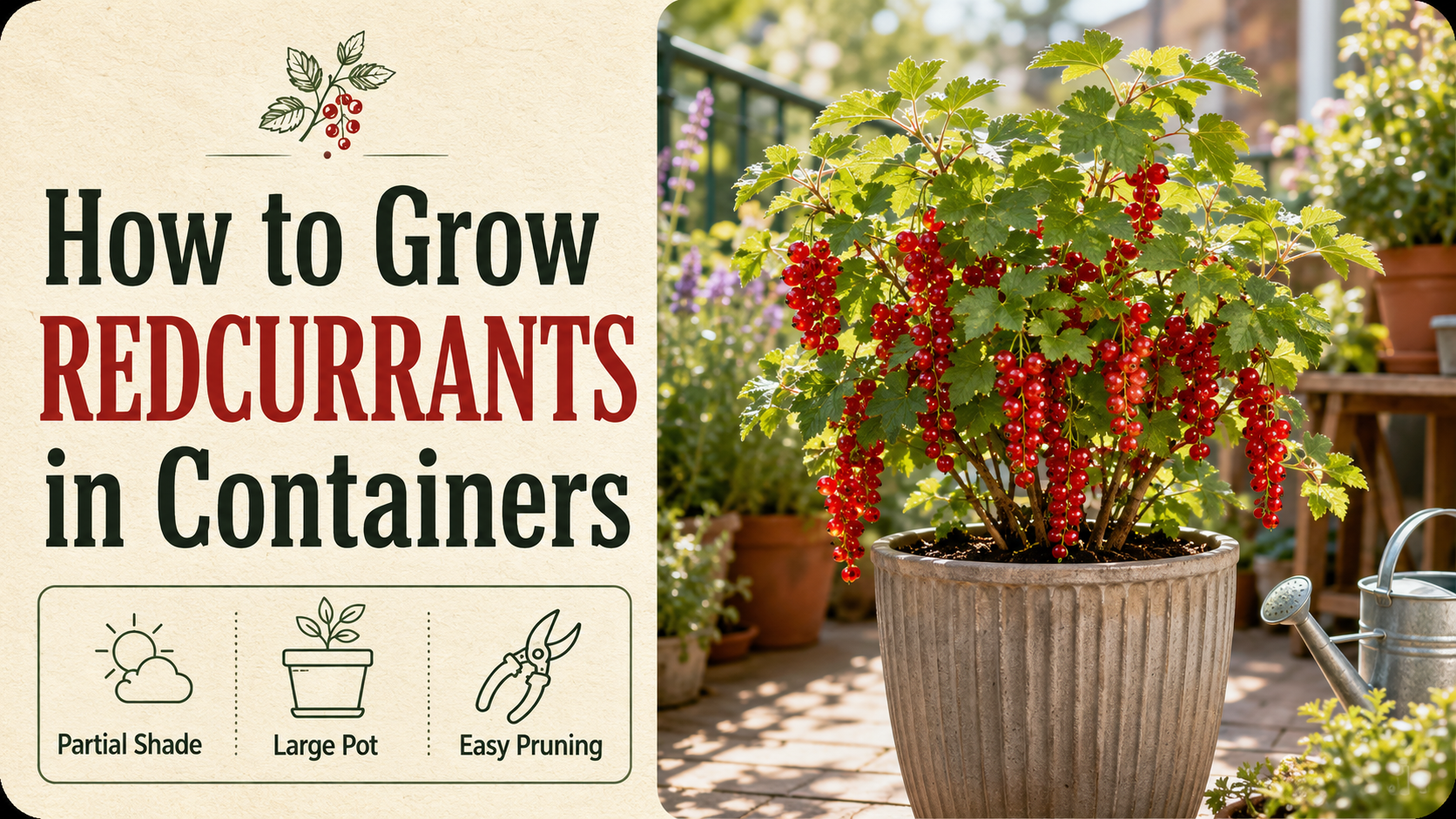
Quick answer: Redcurrants can grow successfully in large containers and tolerate partial shade. Use a pot around 45–50cm wide, plant in a soil-based peat-free compost, keep the plant watered and fed, and prune it annually to maintain an open bush or space-saving cordon shape.
Growing note: Redcurrants fruit on older wood and short fruiting spurs. Pruning them like blackcurrants can remove productive growth.
Quick facts
| Best for | Patios, courtyards, balconies and small gardens |
| Difficulty | Beginner to intermediate |
| Container | Around 45–50cm wide for long-term growing |
| Sunlight | Full sun or partial shade |
| Main care needs | Water, feeding, pruning, support and bird protection |
Why redcurrants suit small gardens
Redcurrants are attractive fruit bushes with hanging clusters of translucent berries. They can be grown as a compact bush or trained as a cordon against a wall, which makes them useful where floor space is limited.
They also tolerate partial shade better than many fruiting plants. A bright north- or east-facing position may still produce a crop, although berries ripen later and may be less sweet than those grown in full sun.
Choosing a plant and shape
| Form | Best use |
| Bush | Simple freestanding plant in a large pot |
| Single cordon | Space-saving vertical form against a wall |
| Double cordon | Decorative trained form with careful support |
| Compact cultivar | Useful for patios and smaller containers |
A bush is easiest for beginners. A cordon takes less horizontal space but requires a permanent support and more precise pruning.
Choosing a container
Use a large stable pot around 45–50cm wide with good drainage. Redcurrants are long-lived shrubs and need enough compost to support consistent moisture and nutrients.
A soil-based peat-free compost is suitable for long-term growth. Lightweight compost alone may dry and shrink too rapidly.
How to plant a redcurrant
- Soak the nursery plant before planting.
- Place the empty pot in its final position.
- Add soil-based peat-free compost to the base.
- Plant at the same depth it was growing previously.
- Firm gently and water thoroughly.
- Add a mulch to conserve moisture.
- Install a permanent support immediately if growing a cordon.
Where to position the pot
Full sun produces the sweetest fruit, but redcurrants grow and crop in partial shade. Choose a sheltered position out of strong wind and protect flowering plants from severe late frost where possible.
If training against a wall, leave enough airflow around the foliage and make sure the support can carry the mature plant.
Watering
Keep the compost evenly moist, especially as flowers and fruits develop. Long-term fruit pots can dry surprisingly quickly during warm weather.
- Water slowly and deeply.
- Check the pot frequently while fruit is swelling.
- Avoid leaving the container permanently waterlogged.
- Mulch the surface each spring.
Feeding
Use a suitable fruit or high-potassium fertiliser according to the label during the growing season. Refresh the top layer of compost annually and repot when root growth becomes congested.
Pruning a redcurrant bush
In winter, remove dead or damaged wood and shorten selected side shoots to maintain an open framework. In summer, shorten new side shoots to encourage fruiting spurs and improve airflow.
Redcurrant pruning differs from blackcurrant pruning. Keep the plant label and follow cultivar-specific advice.
Training a cordon
Tie the main stem to a strong cane or wire support and keep it vertical. Shorten side shoots in summer to form fruiting spurs. A trained cordon can fit beside a doorway or along a narrow wall without becoming a broad bush.
Harvesting
Pick whole strings when the berries are fully coloured. Use scissors to avoid crushing the fruit or damaging the spur. Redcurrants can remain on the bush briefly once ripe, but birds may find them first.
Common problems
Birds strip the crop
Use wildlife-safe netting or a fruit cage before the berries colour.
Leaves become pale
The plant may need feeding, fresh compost or improved drainage. Check root conditions before increasing fertiliser.
The pot dries too quickly
The shrub may be root-bound. Repot during dormancy or improve mulching and watering.
The crop is poor after pruning
Too much older fruiting wood may have been removed. Redcurrants fruit differently from blackcurrants, so use the correct pruning method.
A simple one-pot redcurrant plan
Grow one compact bush in a 45–50cm pot in full sun or partial shade. Keep it watered, feed during the growing season, prune lightly and protect the ripening strings from birds.
For other long-term container fruits, see gooseberries in pots and blueberries in pots.
Choose the best permanent position
Use the growing tools to compare sunlight and floor space before placing a long-term fruit container.
FAQs
Can redcurrants grow in containers?
Yes. Use a large pot, soil-based compost and regular feeding and watering.
Can redcurrants grow in partial shade?
Yes. They tolerate partial shade, although fruit may ripen later and taste less sweet than in full sun.
Do I need two redcurrant plants?
Most redcurrants are self-fertile, so one plant can crop. Check the cultivar description.
How large should the pot be?
A pot around 45–50cm wide is a useful starting point for a long-term fruit bush.
Growing note: Redcurrants are a good option when a patio receives useful light but not the all-day sun demanded by many fruiting crops.