Quick answer: Herbs can grow well on a windowsill if you choose varieties that suit the available light, use pots with drainage and avoid overwatering. Chives, parsley, mint and coriander are forgiving choices for many homes, while basil needs stronger light and warmth. Harvest little and often to encourage fresh growth.
Growing note: A windowsill can look bright to us but still provide weak light for plants. Watch how many hours of direct sun it receives before choosing warmth-loving herbs.
Quick facts
| Best for | Kitchens, bright windowsills, small flats and homes without outdoor space |
| Difficulty | Beginner-friendly if light and watering are matched to the herb |
| Container | Individual pots with drainage holes and saucers |
| Light | Bright light; basil and rosemary prefer the sunniest position |
| Best beginner choices | Chives, parsley, mint and coriander |
Can herbs really grow on a windowsill?
Yes, but the conditions vary enormously. A bright south- or west-facing window can support sun-loving herbs, while a cooler east-facing window may suit parsley, chives and coriander. A dark north-facing sill is more difficult and may need supplemental grow lighting for strong long-term growth.
The simplest approach is to start with two or three herbs you actually use. A windowsill crowded with ten small pots is harder to water, clean and keep healthy than a few well-chosen plants.
Best herbs for a windowsill
| Herb | Windowsill notes |
| Chives | Compact, forgiving and useful for regular cutting |
| Parsley | Tolerates cooler conditions but can germinate slowly |
| Mint | Adaptable; keep it in its own pot |
| Coriander | Useful for repeat sowing but can bolt in heat |
| Basil | Needs warmth and strong light; dislikes cold draughts |
| Thyme | Prefers bright light and free-draining compost |
| Rosemary | Needs the sunniest position and careful watering |
If your kitchen is cool and moderately bright, begin with chives or parsley. If the sill is warm and sunny, basil and thyme become more realistic.
Why supermarket herb pots often struggle
Supermarket herbs are commonly packed with many seedlings in one small pot and grown quickly under protected conditions. They may wilt soon after coming home because they are crowded, the compost dries rapidly or the change in conditions is abrupt.
You can still use them. Harvest some leaves, divide overcrowded plants where appropriate and repot into containers with fresh compost. Do not expect every supermarket pot to become a long-lived houseplant.
Choosing pots and compost
Use pots with drainage holes and place them on saucers or trays to protect the windowsill. Individual pots make it easier to give each herb the right amount of water. Mint, in particular, should have its own container because it spreads strongly.
A peat-free multi-purpose compost suits many leafy herbs. Mediterranean herbs such as thyme and rosemary prefer freer drainage, so add suitable grit or choose a compost designed for that style of plant.
How to sow herbs on a windowsill
- Choose clean pots with drainage holes.
- Fill them with suitable compost and water before sowing.
- Sow according to the seed packet depth and spacing.
- Label each pot with the herb and date.
- Keep the compost lightly moist while seeds germinate.
- Move seedlings into strong light as soon as they emerge.
- Thin crowded seedlings so the remaining plants have airflow and root room.
Light and temperature
Turn pots regularly if the plants lean towards the window. Keep leaves from pressing against very cold glass in winter, and move tender basil away from draughts. In midsummer, a very hot window can scorch leaves and dry small pots quickly, so light shading may help.
If plants become pale, stretched and weak, the likely problem is insufficient light. Moving them closer to the window may help, but a proper grow light may be needed in a consistently dark room.
How to water windowsill herbs
Overwatering is one of the most common problems. Check the compost rather than watering on a fixed daily schedule. Leafy herbs generally prefer more regular moisture than rosemary or thyme, but none should sit in stagnant water.
- Water when the upper compost begins to feel dry.
- Empty excess water from saucers after the pot has drained.
- Use room-temperature water where practical.
- Check small terracotta pots more often because they lose moisture quickly.
Harvesting so herbs keep growing
Harvest little and often. Cut chives close to the base, pinch basil just above a pair of leaves, and take parsley stems from the outside of the plant. Avoid removing most of a young plant at once.
Regular harvesting can keep herbs compact, but a struggling plant needs time to recover. If growth slows during winter, reduce harvesting and watering.
Common windowsill-herb problems
The herbs become tall and floppy
They probably need more light. Move the pots to a brighter position, rotate them and avoid excessive feeding.
Leaves turn yellow
Check for waterlogged compost, poor drainage and cold conditions. Yellowing can also occur naturally on old leaves, but widespread decline usually signals a care problem.
Tiny flies appear around the compost
Fungus gnats favour consistently damp compost. Allow the upper layer to dry appropriately, improve drainage and remove decaying material.
Basil collapses
Cold, overwatering, weak light or root crowding are common causes. Keep basil warm and bright, and do not leave it standing in water.
A simple four-pot windowsill plan
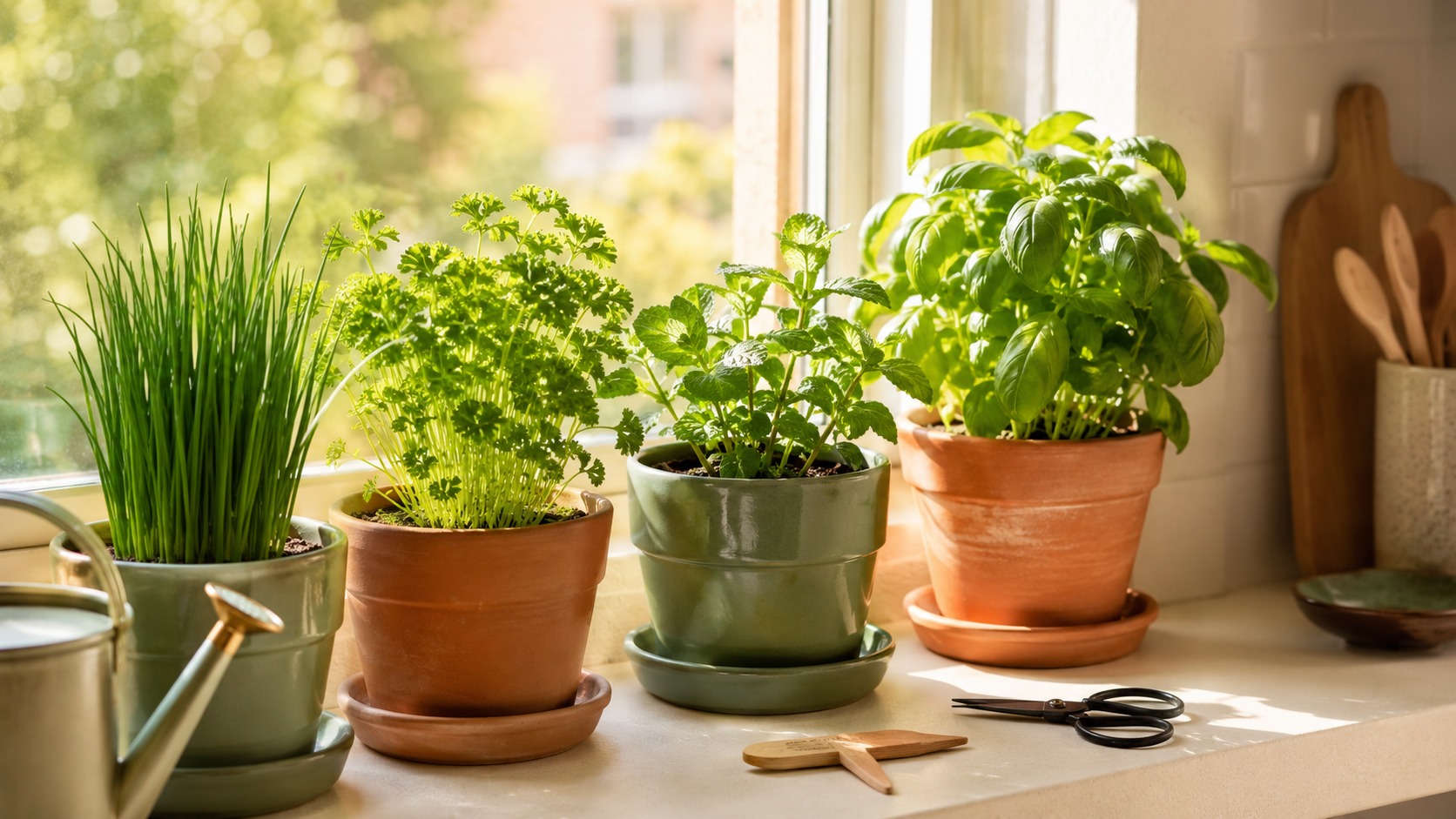
Use one pot each of chives, parsley, mint and basil. Put basil in the warmest, brightest position; keep mint separate; and place chives and parsley where they receive good light without extreme heat. Replace any plant that repeatedly struggles rather than forcing it to survive in the wrong conditions.
Not sure which herbs suit your light?
Use the grow finder to match plants to your space and sunlight before buying more pots.
FAQs
Which herb is easiest to grow on a windowsill?
Chives are a good starting point because they stay compact and recover well after cutting. Parsley and mint are also relatively forgiving.
Can herbs grow on a north-facing windowsill?
Some may survive, but growth can be weak. Choose shade-tolerant leafy herbs and consider a grow light if the room receives very little direct sun.
Should each herb have its own pot?
Usually, yes. Separate pots make watering easier and prevent vigorous herbs such as mint from overwhelming slower plants.
How often should I replace windowsill herbs?
Annual herbs such as basil and coriander are naturally short-lived. Perennial herbs can last much longer if the light, roots and watering are suitable.
Growing note: Match the herb to the windowsill rather than choosing only by appearance. Good light and sensible watering matter more than decorative pots.