Container Drainage and Pot Feet: Getting Pots Through Winter
A practical guide to winter drainage for pots and containers: pot feet, drainage holes, saucers, frost-resistant pots, grouping, wrapping and winter watering.
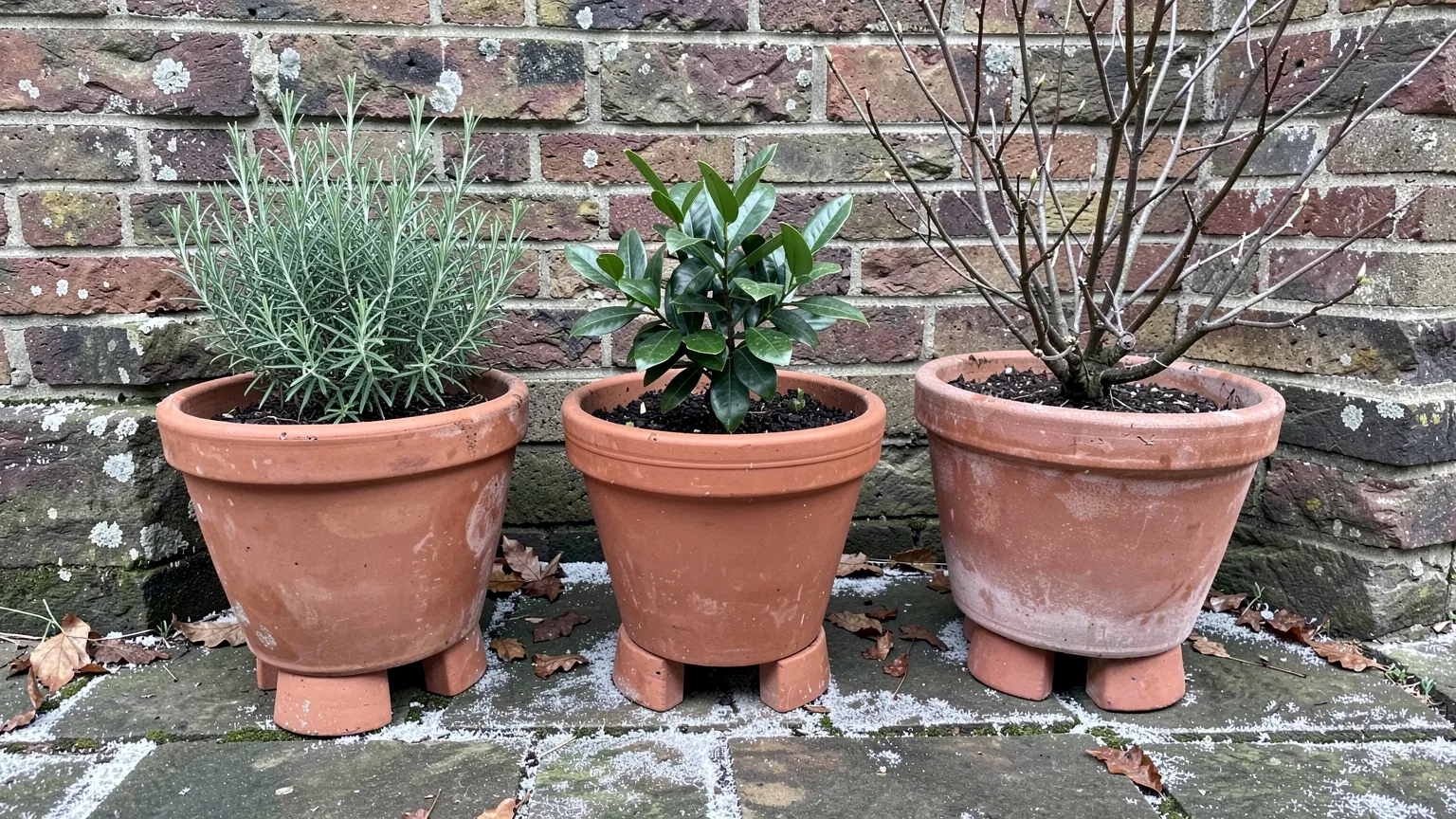
Quick answer
In winter, container plants are more often killed by cold, wet compost than by cold alone. Make sure every pot has clear drainage holes, raise it off the ground on pot feet or bricks so water can run away, take away saucers that hold water, and group pots in a sheltered spot. Wrap the pots of tender or prized plants in hard frost, and water only when the compost is actually dry.
Growing note: A pot that sits in a puddle all winter is a pot that never drains. Lifting it just a few centimetres off the ground makes a real difference.
Quick facts
| When to do it | Autumn, before the wettest and coldest weather |
| Difficulty | Easy, and mostly a one-off job |
| Main tools | Pot feet or bricks, a stick to clear holes, hessian or bubble wrap |
| Most at risk | Mediterranean herbs, fruit bushes, plants in pots without holes |
| Biggest mistake | Leaving pots in saucers or flat on the ground |
| Winter watering | Only when the compost is dry, never when frozen |
Why winter wet is the real problem
Roots need air as well as water. In summer, plants use water quickly and compost dries out between waterings. In winter, growth slows right down, rain keeps coming and the compost stays cold, so water lingers. Roots sitting in cold, airless compost can rot, and the damage often only shows in spring when the plant fails to grow.
Many hardy plants cope with frost far better in well-drained compost than in wet. Rosemary, thyme, sage and oregano in particular are much more likely to be lost to winter wet than to cold.
Wet compost also makes frost damage to the pot itself more likely. Water held in the compost and in the walls of porous pots expands when it freezes, which can crack or flake terracotta.
Check every pot has drainage holes
Start by tipping each pot slightly and looking underneath.
- Clear blocked holes. Roots, compost and snails can plug drainage holes. Poke them clear with a stick or a pencil.
- Pots with no holes. Decorative pots often have none. Either use them as an outer pot, with a plastic pot inside that you can lift out to drain, or drill holes. A masonry or tile drill bit at a slow speed, with masking tape over the spot to stop it slipping, works for most ceramic and terracotta pots.
- Self-watering pots. Empty the reservoir in autumn and open any overflow plug so rain cannot fill it.
- Troughs and window boxes. Check holes along the whole length, as long containers often have only one or two.
Using pot feet
Pot feet are small blocks, usually made of terracotta, stone or rubber, that lift a pot a few centimetres off the ground. That small gap lets water drain freely out of the holes instead of pooling underneath, lets air reach the base of the pot and stops the pot freezing to the paving.
- Use three feet for a small or round pot and three or four for a larger one, spaced evenly near the edge of the base.
- Keep the feet away from the drainage holes so they do not block them.
- Check the pot sits level and does not rock. Tall pots on a windy balcony need a wide, steady base.
- Lift heavy pots with a helper, or tilt them and slide the feet in one side at a time.
You do not need to buy anything special. Bricks, offcuts of paving, old tiles or short lengths of wooden batten all work. On a balcony, rubber pot feet or small plastic risers are lighter, do not scratch the floor and are less likely to slide.
Saucers and trays in winter
Saucers are useful in summer, but in winter they hold rainwater against the base of the pot for days. Take them away for the winter, or empty them after every spell of rain. If you need a saucer to protect a floor or stop drips onto a balcony below, raise the pot on feet inside a deeper tray so it sits above the water, and tip the water out regularly.
Do you need crocks or gravel?
A layer of broken pot or gravel in the bottom of a container is a traditional habit, but it does not make the compost drain better. Water tends to collect in the compost just above the layer before it drains into it, so it can actually leave the roots wetter. Good drainage comes from clear holes, a free-draining compost and raising the pot off the ground.
A single piece of broken pot or a square of mesh over a large hole is fine for stopping compost washing out. For Mediterranean herbs, mixing some horticultural grit into the compost when you plant helps far more than a layer at the bottom.
Choosing pots that last through frost
Terracotta, glazed ceramic and concrete all vary in how well they cope with frost. Look for pots labelled frost-resistant or frost-proof, and check what the maker says, as some offer a guarantee and others do not. Cheap, thin terracotta is the most likely to flake or crack.
- Pots with a rim narrower than the middle are hard to get plants out of, and the frozen root ball can push against the sides. Straight or flared pots are safer.
- Plastic, fibreglass and wooden containers do not crack in frost, but thin plastic gives the roots less protection from cold.
- Empty pots you are not using are best stored upside down or under cover, so they do not fill with water and freeze.
Grouping, shelter and wrapping
Roots in pots are more exposed to cold than roots in the ground, because the cold can reach them from every side. A few simple steps help:
- Group pots together. Containers huddled against a house wall shelter each other from wind and frost.
- Use the warmest spot you have. A wall that gets winter sun, or a corner out of the wind, is a few degrees milder than an open patio.
- Wrap pots in hard frost. Hessian, bubble wrap or an old blanket around the pot protects the roots of fruit bushes, bay and other prized plants. Leave the compost surface uncovered so rain can still reach it and the plant is not sealed in.
- Use fleece for tender tops. Horticultural fleece over the plant itself helps on the coldest nights, but take it off in milder weather.
Watering pots in winter
Most pots in the open get all the water they need from rain. The exception is pots under eaves, on covered balconies or against walls where rain does not reach. These can dry out even in winter, especially evergreen plants that keep losing water through their leaves.
- Check the compost a few centimetres down with your finger before watering.
- Water in the morning on a mild day, so the excess drains before night.
- Never water frozen compost. Wait until it thaws.
- Stop feeding. Plants that are barely growing cannot use it.
What to check through the winter
- After heavy rain, look for pots where water is sitting on the surface. That usually means a blocked hole.
- After frost, check newly planted garlic and onion sets, as frost can lift them out of the compost. Gently push them back in.
- After strong winds, check tall pots and anything on a balcony is still steady.
- Every few weeks, pick off dead or yellow leaves that could rot on the compost surface.
Crops and plants that benefit most
Good drainage matters for anything left in a pot outdoors over winter. In a tiny garden, that often includes broad beans sown in autumn, kale, Swiss chard, winter salad leaves, woody herbs and fruit bushes such as blueberries, blackcurrants and gooseberries. For the rest of the month's jobs, see what to sow in December.
Check your container sizes
Use the free tools to see how big a pot each crop needs, and which crops suit your space.
FAQs
Do pots need to be raised off the ground in winter?
It helps a lot. Raising pots on feet or bricks lets water drain away freely, stops them sitting in puddles and prevents them freezing to the paving.
Should I remove saucers in winter?
Yes, for pots outdoors. Saucers hold water against the base of the pot, which keeps the compost wet. If you need one to stop drips, raise the pot on feet inside it and empty it regularly.
Will terracotta pots crack in frost?
Some do. Frost-resistant or frost-proof pots cope best, and keeping any terracotta pot well drained and raised off wet ground reduces the risk.
Should I water container plants in winter?
Only when the compost is dry, which mostly applies to pots sheltered from rain. Never water frozen compost.
Do I need to put crocks in the bottom of pots?
No. A layer of crocks or gravel does not improve drainage. Clear drainage holes, free-draining compost and pot feet matter much more.
Growing note: Clear the holes, lift the pots, lose the saucers and group them somewhere sheltered. Those four jobs see most container plants safely through winter.